
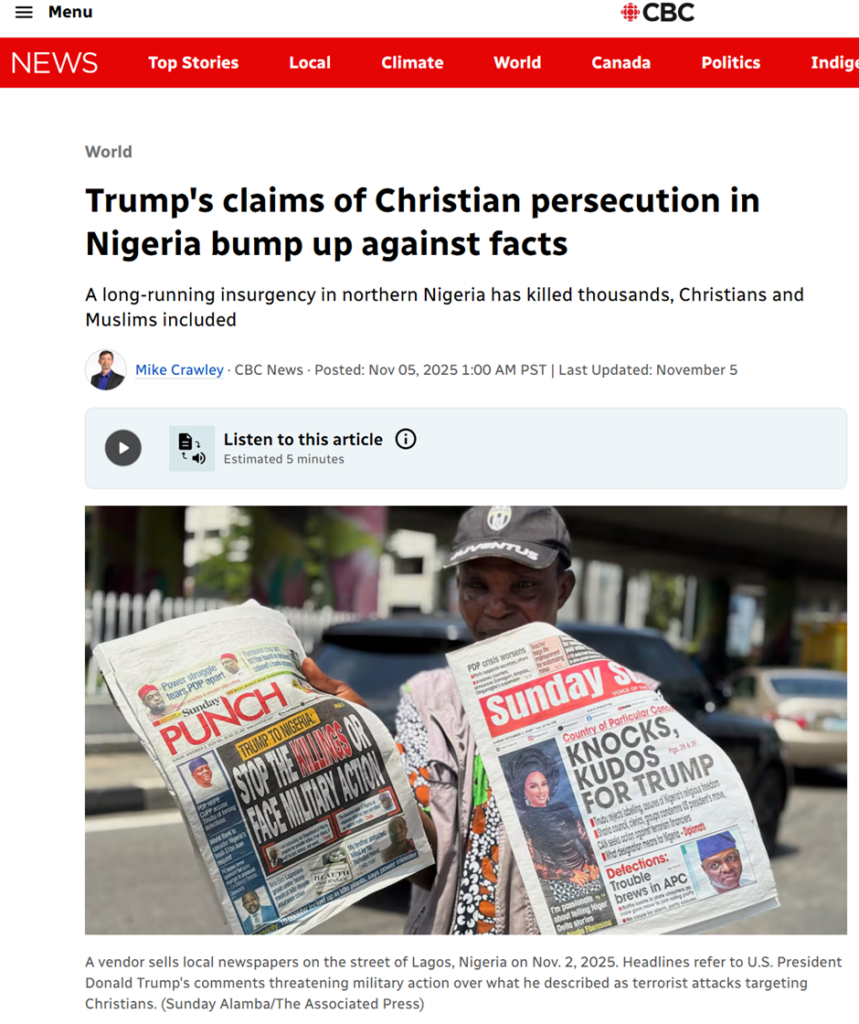
Having the case of the Nigerian Civil War in mind when I undertook the coursework, Genocide in the 20th Century by Prof. Jeff McLaughlin and Prof. Rick McCutcheon, I was keen to learn the definition of the word genocide as a human rights and social justice scholar. As the course went on and the definition became clearer, I thought about Nigeria and especially Northern Nigeria, where violence and killings have been on repeat since the beginning of the year 2000. According to a report by Genocide Watch authored by Bhattacharjee (2024), more than 62,000 Christians have been killed in what some organisations and scholars call genocide that is carried out by the Islamist jihadist groups, including Boko Haram, the Islamic State West Africa Province (ISWAP), and the Fulani militias and these killing have been termed terrorism or banditry by the Nigeria government. We are approaching the end of 2025, and Christians are still being killed daily, communities are being destroyed, and their means of living are ruined.
I have found the coursework in Genocide in the 20th Century incredibly valuable, as it gave me a real sense of human rights by placing the targeted murdering of Christians in northern Nigeria within a broader context of a structural attack on group rights and identity. The course has taught me to be more aware of the fact that violations of human rights are usually either the product of purposeful efforts to annihilate specific communities, which is the essence of the definition of genocide as described in the UN Convention on Genocide (United Nations, 1948) and which I covered during the course.
My understanding of the violence in northern Nigeria before reading the course material was mainly conflict-based or terrorism based. Nonetheless, the interdisciplinary approach of the course provoked me to critically examine the killings in terms of collective targeting and destruction based on identity. This change of mind has highlighted that the security of human rights is to be pursued through both structural and intentional efforts to annul groups since it is seen with the current attempts by militant factions to drive out Christians, burn churches, and suppress religious liberty in northern Nigeria (Kefas, 2025). The concept of intent to destroy, either wholesale or in part, which was one of the foundations of the law of genocide, helped clarify the frequent patterns of occurrence in this violence as more than mere accidental but a premeditated assault on the existence of a religious minority group.
As a case study, the 20th-century genocides (the Armenian genocide and the Holocaust) taught me the crucial ethical lessons about the roles of the perpetrators, observers, and the international community. Such a historical basis compels me to ask questions about the way the world reacts to the suffering of Nigerian Christians, reflect on the systems of denial, memory, and justice, and to take up the cause of greater human rights protection and accountability in the present.
Moreover, the focus on the language, memory, and moral responsibility taught in the coursework has helped me realise the strength of discourse, how words such as genocide or persecution are employed to invoke the mobilisation of international intervention and legal redress(DW, 2025). This situates existing arguments on the subject of defining violence in Nigeria and the necessity to focus on human rights advocacy based on good, serious academic work.
In general, the critical thinking developed through this course has helped me to shift my perception of human rights from a general, and in many cases, an abstract meaning to a narrowed-down imperative in discriminating and eliminating a specific group of people. The killings in northern Nigeria are a tragic and critical case, which, through the lens of genocide studies, needs ethical and practical intervention on an immediate scale, not only to rescue lives but also to maintain the dignity and identity of the endangered communities.
This deeper insight places my human rights practice in the context of continual efforts to avoid genocides and mass atrocities around the world, and the lessons of the 20th century appear to be highly applicable to the present-day challenges.
References:
Bhattacharjee, S. (2024). Nigeria: Genocide Watch report on Christian killings. Genocide Watch.
United Nations. (1948). Convention on the Prevention and Punishment of the Crime of Genocide. United Nations Treaty Series, 78, 277.
Kefas, S. (2025). Fulani militias and civilian killings in Nigeria (2019–2024). Security analysis report.
Deutsche Welle (DW). (2025). Nigeria’s crisis: Religion, violence, and the risks of oversimplification. DW News