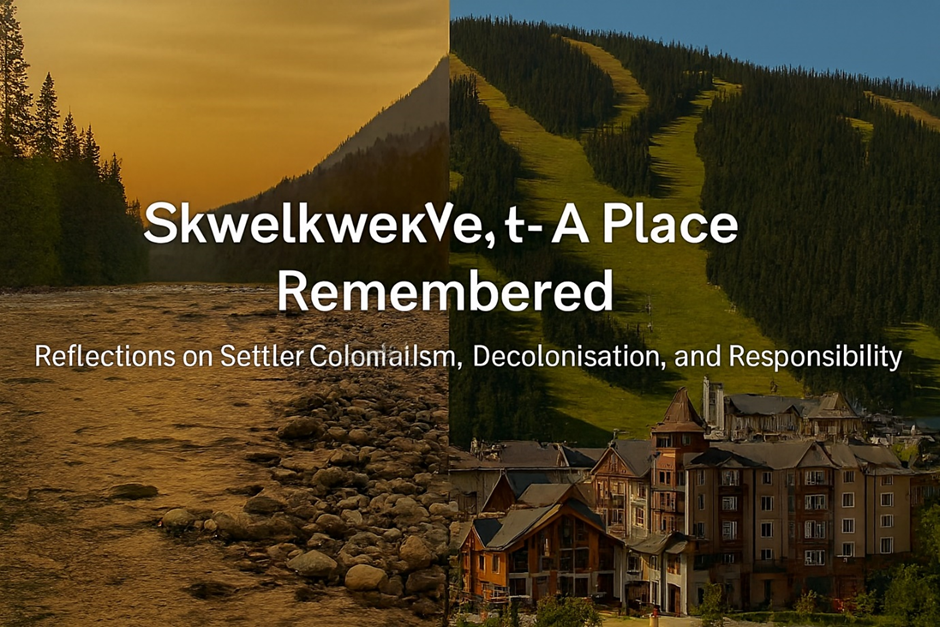
This course challenged me to rethink what land means, not only in theory but in my own life. Looking back at my experience in Settler Colonialism: Decolonisation and Responsibility, I realize how much it reshaped my understanding of land and justice.
Looking back at my experience of being enrolled in the course “Settler Colonialism: Decolonisation and Responsibility,” I noticed that the study of the place made me see things in a much different way. My main preconception about land before this course was mostly in the practical sense, in terms of boundaries and ownership. Nevertheless, in books such as Unsettling Canada, particularly the story of Skwelkwek’welt (now Sun Peaks) by Arthur Manuel- Unsettling Canada link to e-book, I was able to understand that a place has a deeper meaning to people in other situations.
I was made aware of the fact that place is closely intertwined with emotion, memory, sense of belonging and identity among Indigenous people. A place is not merely a geographic area, but the source of the culture, spiritual practice and the transmission of knowledge between generations.
The life of Skwelkwek’welt is an indicator of the interference of such meanings by settler colonialism. Manuel explains how this region, which was once a rich source of plant foods, roots, berries and stalks and also a hub of wildlife, was a lively place to nourish, acquire cultural knowledge and perform religious rites. It was the location where young Secwepemc are tied to their ancestry of traditional teachings and where families convene to harvest and celebrate seasonal rituals. This is the perfect example of erasing the culture: instead of medicine harvesting, spiritual healing, and cultural continuity. It is now a strory of environmental depletion, economic marginalization and social injustice have taken their place in Skwelkwek’welt’s transformation into Sun Peaks Resort.
Discovering the story of the Secwepemc people’s displacement and seizure of their worship and meeting places made me see the long-term impact of colonization.
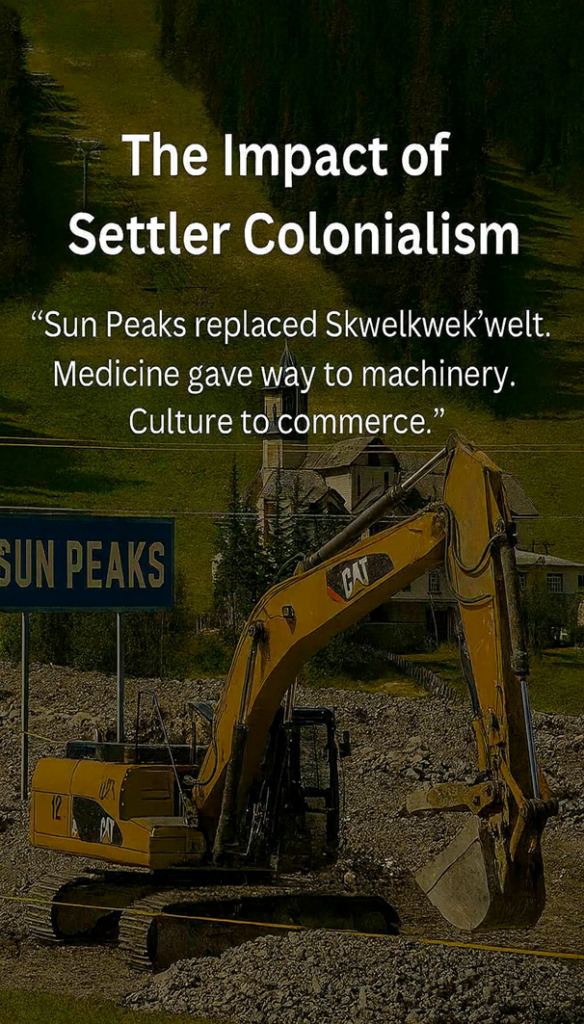
The land was not only taken, but it was reorganized, its traditional meanings banished, and turned into a commodity. As a result, the Secwepemc did not have access to healing ceremonies, aboriginal foods, and sites. The memory and the cultural knowledge became endangered, and the cultural attachments to the spaces were additionally broken as a result of the litigation about land rights. The witnessing of Manuel, and an examination of the words of community leaders, prove the fact that settler colonialism remains not a thing of the past but of a system of injustice that has developed and is still functioning nowadays, and that is creating a new tourist destination and a new livable territory, destroying the inheritance of Indigenous people.
These considerations indicate that in a colonial system, the place represents both the process of dispossession as well as a site of resistance. Those lessons acquired during the course make me acknowledge the presence of Skwelkwekwelt in the past and its importance in the present, and the resilience of Indigenous people who do not surrender and still protect their lands, cultures, and identities despite their hardships.